Hey there! I’m a supplier of portable oil purifiers, and I’m stoked to share with you the key components of these nifty machines. Portable oil purifiers are super handy for all sorts of industries, from manufacturing to automotive to power generation. They help keep your oil clean, extend its lifespan, and reduce equipment wear and tear. So, let’s dive right in and take a look at what makes these purifiers tick. Portable Oil Purifier
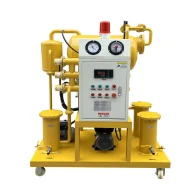
Inlet and Outlet Ports
First off, we’ve got the inlet and outlet ports. These are like the doorways of the oil purifier. The inlet port is where the dirty oil comes in. It’s connected to the source of the oil, whether it’s a storage tank, a piece of equipment, or whatever. The design of the inlet is important because it needs to make sure the oil can flow smoothly into the purifier. You don’t want any clogs or restrictions here.
On the other side, we have the outlet port. This is where the clean oil goes back out. It’s connected to where the oil needs to be reused. The outlet also has to be designed well to ensure that the purified oil can flow out easily and get back into the system.
Pumps
Next up, pumps are a crucial part of the portable oil purifier. These bad boys are responsible for moving the oil through the purifier. There are different types of pumps you can use, like gear pumps, vane pumps, or centrifugal pumps. Each type has its own pros and cons.
Gear pumps are pretty simple and reliable. They work by meshing gears that move the oil from the inlet to the outlet. They’re good for transferring oil at a relatively constant flow rate. Vane pumps, on the other hand, use vanes that slide in and out of a rotor to create suction and move the oil. They can handle a bit more pressure than gear pumps in some cases. Centrifugal pumps use a spinning impeller to create a centrifugal force that moves the oil. They’re great for high-flow applications.
Filters
Filters are the heart and soul of an oil purifier. They’re what actually clean the oil. There are different levels and types of filters in a portable oil purifier.
The first type is usually a pre – filter. This is a coarse filter that catches the big stuff, like dirt, debris, and large particles. It helps protect the more sensitive and finer filters downstream. Pre – filters are often made of materials like mesh or felt.
Then we have the main filters. These can be made of various materials such as cellulose, synthetic fibers, or even activated carbon. Cellulose filters are common and are good at removing solid particles. Synthetic fiber filters are more durable and can handle higher pressures. Activated carbon filters are great for removing contaminants like water, acids, and some dissolved impurities by adsorption.
Water Separation System
Water in oil is a real problem. It can cause corrosion, reduce the lubrication properties of the oil, and lead to equipment failure. That’s why a water separation system is a key component of a portable oil purifier.
One common method of water separation is coalescence. In a coalescing filter, tiny water droplets in the oil are combined into larger droplets. These larger droplets then settle out of the oil due to gravity. Another method is vacuum dehydration. In a vacuum chamber, the oil is heated and the water in it evaporates at a lower temperature because of the reduced pressure. The water vapor is then removed from the chamber.
Heating System
A heating system is also an important part of a portable oil purifier. Heating the oil can lower its viscosity, which makes it easier for the oil to flow through the filters and also helps with the water separation process. For example, when the oil is heated during vacuum dehydration, the water evaporates more easily.
The heating system usually consists of heating elements, like electric heaters. These elements are carefully controlled so that the oil doesn’t get over – heated, which could damage the oil or the purifier components.
Control Panel
The control panel is like the brain of the portable oil purifier. It allows the operator to control and monitor the whole purification process. You can set things like the flow rate of the oil, the temperature of the heating system, and the pressure in different parts of the purifier.
The control panel often has indicators to show the status of the purifier, like whether the filters are clogged, if the water level in the separation system is too high, or if there’s an issue with the pumps. Some advanced control panels even have digital displays and can be connected to a computer for remote monitoring and control.
Monitoring Sensors
Monitoring sensors are all over the place in a portable oil purifier. There are pressure sensors that measure the pressure of the oil at different points. If the pressure is too high or too low, it could indicate a problem, like a clogged filter or a malfunctioning pump.
There are also temperature sensors that monitor the temperature of the oil. This is important to make sure the heating system is working correctly and that the oil isn’t getting too hot. And water sensors are used to detect the amount of water in the oil. They help the water separation system work effectively and can alert the operator if there’s too much water in the oil.
Housing and Frame
Last but not least, we have the housing and frame of the portable oil purifier. The housing protects all the internal components from dust, moisture, and other environmental factors. It’s usually made of a strong material like steel or aluminum.
The frame provides support for all the parts and makes the purifier easy to move around. Portable oil purifiers need to be mobile, so the frame is designed to be sturdy but also lightweight. Some frames even have wheels or handles to make it super easy to transport the purifier from one place to another.
Why Choose Our Portable Oil Purifiers?
Our portable oil purifiers are top – notch. We use high – quality components in all of our products. Our pumps are reliable and can handle different types of oils. The filters we use are designed to be very efficient at removing contaminants, whether it’s solid particles, water, or dissolved impurities.
Our water separation system is state – of the – art. It can remove water from the oil quickly and effectively, which helps to keep your equipment running smoothly. The heating system is also carefully calibrated to ensure the right temperature for optimal purification.
The control panel is user – friendly. You don’t need to be a tech genius to operate it. And the monitoring sensors give you real – time information about what’s going on inside the purifier.

If you’re in the market for a portable oil purifier, I’d love to talk to you. Whether you’re a small business or a large industrial operation, we’ve got a solution for you. Contact us to discuss your specific needs, and we’ll work with you to find the perfect portable oil purifier for your situation.
References
- "Handbook of Industrial Oil Management"
- "Oil Purification Technology: Principles and Applications"
Portable Oil Purifier So, that’s a wrap on the key components of a portable oil purifier. I hope this blog has given you a better understanding of how these machines work and why they’re so important. If you have any questions or want to learn more, just reach out!
Chongqing TOP Oil Purifier Co., Ltd.
Chongqing TOP Oil Purifier Co., Ltd. is one of the most experienced portable oil purifier manufacturers and suppliers in China. Please rest assured to buy CE approved portable oil purifier made in China here from our factory. We also accept customized orders.
Address: No.1, Jianlong North Rd, Jiulongpo District, Chongqing, China
E-mail: sales@topoilpurifier.com
WebSite: https://www.xboilpurifier.com/
