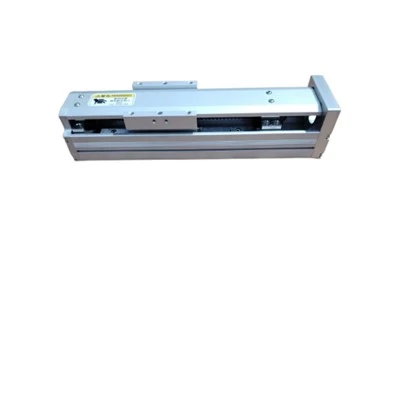
Industrial Belt Guide Rail Drive Module Hey there, if you’re shopping around for linear motion parts, you’ve definitely wondered at some point: can I just get a ball screw linear module that fits my exact setup, instead of forcing my project to work with something generic? As someone who’s spent the last decade working with ball screw linear modules—answering emails, troubleshooting, and tweaking designs for everyone from hobbyists building CNC routers to big manufacturing lines cranking out auto parts—I’m here to tell you straight up: yeah, they totally can be customized. But before you go firing off a 10-paragraph request like “needs to move 12.345 pounds at 0.789 ft/sec in a 17.25-inch path in stainless steel,” let’s break this down like we’re grabbing coffee (well, like I’m grabbing coffee, you’re reading this on your lunch break). First off, let’s cut through the jargon—when people ask about customizing ball screw linear modules, they’re not just talking about painting the casing. This is about tailoring every part of the module to your specific use case, because generic off-the-shelf modules are built for “average” needs, and average never works when you’ve got weird constraints. Let’s start with the basics: what actually makes a ball screw linear module customizable? First up is the travel length. Most off-the-shelf modules come in lengths like 100mm, 200mm, 300mm—standard stuff. But what if your machine only needs a 472mm travel, not a full 500mm? Or what if you need a super short travel, like 25mm, for a tiny medical device? We don’t have to waste material cutting down a longer module (which would leave rough edges or weird tolerances) — we can machine the linear rail and cut the ball screw to exactly the length you need. No extra dead space, no wasted parts, perfect fit. Then there’s the load capacity. Off-the-shelf modules are rated for, say, 50kg, 100kg, 200kg. But what if your application has a dynamic load of 187kg, or you need to handle static loads for a pick-and-place robot that’s got a heavy gripper? We can swap out the ball screw diameter, the nut size, even the linear bearings to handle exactly what you need. I’ve had a customer a few years back in the automotive industry who was building a part transfer line—they needed a module that could hold a 300kg engine block, but also move it fast. Off-the-shelf modules topped out at 250kg, so we upped the ball screw from 16mm to 25mm, beefed up the linear rails, and adjusted the preload on the nut so there was no slop when moving heavy loads. That project ran for 7 years without a single failure—way better than if they’d forced a generic module that was underrated. Speed is another big one. Generic modules are built for mid-range speeds, like 1m/s, but what if you need to move super fast, like 3m/s, for high-speed packaging? Or super slow, like 0.01m/s, for a precision dispensing machine? For fast apps, we can go with a ball screw with a larger lead—so each rotation moves more linear distance, meaning faster travel. For slow, precise apps, we use a smaller lead ball screw and tighten up the preload to eliminate play, so every movement is dead accurate. I once worked with a startup that was building a lab automation pipetting machine—they needed to move just 10mm, super slow and super precise, to dispense tiny volumes of liquid. A generic module would have moved too fast and had enough slop to throw off their measurements. We customized the lead to 1mm, set the preload to zero backlash, and got them exactly the movement they needed. No more bad test results from wonky positioning. Next up: mounting and interfaces. This is where most people run into trouble with generic modules. Your motor’s got a different shaft size than the standard module’s mounting flange? Your machine’s base has weird bolt holes that don’t line up with standard module mounting holes? Or you need a specific bracket for a gripper or sensor? We can machine custom mounting flanges, adjust the hole patterns, even add custom brackets for whatever tooling you’re attaching. I had a customer who was building a CNC router for custom furniture—their router spindle was a non-standard size, and the generic module’s flange didn’t fit. Instead of making a custom adapter that would add slop, we machined a custom flange that bolted directly to their spindle, so the alignment was perfect. Their router cuts are now precise enough for people to build custom cabinets that fit like a glove. Material is another customization point. Most modules come with aluminum casings for lightness, but what if you need stainless steel for a food or medical application? Or you need a hardened steel rail for harsh environments where there’s dust or debris? A while back, we worked with a company making food packaging equipment—their modules were getting exposed to cleaning chemicals that corroded aluminum. We swapped the casing and linear rail for 304 stainless steel, so it holds up to daily high-pressure washing without rusting. That’s the kind of customization you just can’t get with off-the-shelf. Wait, but hold on—customization doesn’t mean it takes 6 months and costs a fortune, right? A lot of people hear “custom” and assume it’s a nightmare, but that’s not true here. We’ve streamlined our process so we can handle most custom requests in 2-4 weeks, not months, and the cost is only a bit more than a generic module—usually 10-20% extra, which is nothing compared to the hassle of forcing a wrong part into your project. The key is that we work with you step by step, not just drawing up a part and sending it off. We’ll ask about your load, speed, travel length, environment, mounting, even what kind of motor you’re using, and tweak the module to fit. But here’s the thing: not every “request” is actually a customization. I get emails all the time that say “can you make me a module for a robot?” and that’s too vague. To make a real custom module that works, you need to have a few details figured out first. Know how much weight you’re moving, how fast you need to move it, how far it needs to go, what environment it’s in (dirty, wet, cold, etc.), and how you’re mounting it. If you have those numbers, we can build you something perfect. Let’s also talk about why this matters for your project. If you use a generic module that’s not right for your application, you’re risking downtime, precision issues, even safety. I’ve seen projects where someone used a module that was rated for half the load it needed, and it broke mid-production, shutting down a whole line for 3 days. That’s way more expensive than paying a little extra for a custom module that fits perfectly. And it’s not just for big companies—hobbyists and small startups can get custom modules too. I’ve worked with a guy building a 3D printer that was way bigger than standard printers, so he needed a custom travel length for the Z-axis. We built him a module that fit his exact printer frame, no modifications needed. Now he’s selling his custom printers, and that module is a big part of their success. Wait, but is there anything you can’t customize? Let’s be real—no, not really, within reason. If you need a module that moves 10 tons, we can adjust the ball screw and rails to handle that. If you need one that works in a vacuum for space equipment, we can use special lubricants that don’t outgas. The only limits are if it’s something totally impossible, but 99% of the requests we get are totally doable. So if you’ve been struggling with a linear module that’s almost right, but not quite, stop forcing it. Ball screw linear modules can absolutely be customized, and it’s way easier and more affordable than you think. We’re here to help you figure out exactly what you need, no confusing jargon, no runaround. If you’ve got a project that needs a linear module that’s not off the shelf, hit us up, tell us about your needs, and we’ll work with you to build something perfect. Whether you’re a small hobbyist or a big manufacturing line, we’ve got you covered. Don’t waste another day with a part that’s causing problems. Reach out to us to talk through your project and get a custom ball screw linear module that fits like it was made just for you.
References Ball Screw Linear Modules
- Bolton, W. (2019). Mechanical Engineering Systems: Theory and Practice. Routledge.
- Oberg, E., Jones, F. D., Horton, H. L., & Ryffel, H. H. (2020). Machinery’s Handbook (31st ed.). Industrial Press.
- ASME B5.47-2019, Ball Screws for Machine Tools. American Society of Mechanical Engineers.
Yangning (Xiamen) Intelligent Technology Co., Ltd.
With abundant experience, we are one of the most professional ball screw linear modules manufacturers in China. As we have world-leading production equipment and strong manufacturing capabilities, we warmly welcome you to buy bulk advanced ball screw linear modules from our factory. Customized orders are welcome.
Address: Room 307-2, No. 15 Duiying Road, Software Park Phase III, Torch Hi-Tech Zone, Xiamen, Fujian, China
E-mail: mia@ynautos.com
WebSite: https://www.ynautos.com/
