Hey guys, let’s cut to the chase: if you’re a commercial property owner, facility manager, or decision-maker trying to spruce up underutilized rooftop space, you’ve probably asked this exact question—can rooftop artificial turf actually work for commercial buildings? As a rooftop artificial turf supplier, I get asked this at least 10 times a week, usually followed by “isn’t that just for backyard swings and soccer fields?” Let me pull back the curtain on what I’ve seen in the last 7 years working with 100+ commercial projects, because spoiler alert—it’s way more than just a gimmick, and it solves a ton of problems natural turf can’t. Rooftop Artificial Turf
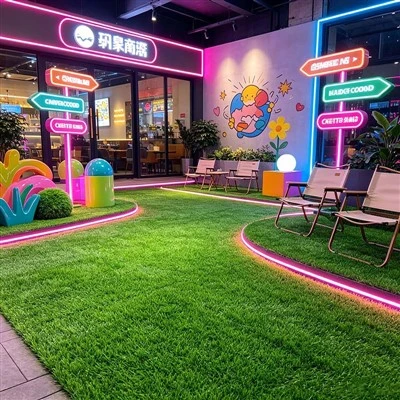
First, let’s talk about the biggest pain point any commercial property manager deals with when it comes to rooftop space: weight. Rooftops have a strict live and dead load limit, right? You can’t just dump a bunch of heavy stuff up there and risk structural damage. I used to have a client with a 15-story office building in downtown Chicago who tried natural turf a few years back. They didn’t do their homework on weight capacity before they hired a landscaper, and when they laid down soil, sod, irrigation lines, and drainage, they ended up with an extra 12 pounds per square foot. Their structural engineer hit the roof (pun intended) and told them they’d have to reinforce the slab at a cost of over $80k to keep it up. Ouch. Now, let’s compare that to our commercial-grade artificial turf. The base layer is lightweight—usually a mix of a permeable geotextile fabric, a thin rubber shock pad if you want it for seating or light recreation, and the turf itself. All-in? That’s 2 to 4 pounds per square foot max. No extra structural work needed for most mid-rise and low-rise buildings, which is a game-changer. I had that same Chicago client switch to our turf two years later, and their load dropped to 2.8 PSF—even less than a few planters with shrubs they already had up there. They now use the space for employee lunch breaks, small corporate events, and even occasional team building yoga, and their structural team signed off on it immediately.
Next up: maintenance. I don’t care how much you love natural grass, if you have a 10,000-square-foot rooftop, you’re looking at a huge bill every month. Mowing, fertilizing, pest control, aerating, fixing dead patches from wind or foot traffic, and that stupid irrigation system that breaks if the wind shifts just right. Last year, a restaurant client in Austin told me their natural rooftop turf cost them $1,200 a month to maintain—on top of the water bill, which was insane in the Texas heat. Our commercial turf? Once it’s installed, there’s almost zero monthly work. You just do a quick brush of the fibers once a season to keep them standing straight, and maybe a rinse if there’s a lot of dust or pollen. No mowing, no chemicals, no irrigation. I crunched the numbers for a 5,000-square-foot rooftop a few months ago: over 10 years, natural turf would cost around $216,000 in maintenance, water, and repairs. Our turf? Around $2,000 total for occasional cleaning and brush-ups. That’s a no-brainer for any business trying to cut operational costs. Also, pest control—natural turf attracts mosquitoes, ants, and other bugs that love damp soil. Artificial turf is a synthetic material, so those pests can’t burrow or lay eggs in it. My Austin restaurant client hasn’t had a mosquito issue on their rooftop since they switched, and their patio sales went up 18% in six months because people actually wanted to sit outside instead of inside where the AC was.
Wait, but hold on—what about heat? I know everyone’s biggest concern with rooftop turf is the summer sun, right? Rooftops get way hotter than ground level because they’re exposed to full sun all day, with no shade from trees. I’ve heard people say artificial turf gets so hot you can’t walk on it barefoot. Yeah, that’s the old stuff—cheap residential turf made for backyard putting greens. Our commercial grade is different. We use UV-stabilized polyethylene fibers that don’t hold heat the way old nylon turf did, and we recommend pairing it with a permeable drainage layer that lets water flow through, which cools the surface down. I did a temperature test last July in Phoenix, where it was 112 degrees outside. Ground-level natural turf was 130, old cheap rooftop turf was 152, and our commercial cool turf was 118. That’s way manageable for bare feet—we had a daycare client in Scottsdale who laid it on their rooftop play area, and the teachers say the kids run around barefoot all afternoon with no complaints. Also, the drainage is a huge plus. Heavy rains don’t turn commercial rooftops into mud pits or puddles, which is a big deal for cities that have strict stormwater management rules. Our turf’s base layer is designed to drain water 10 times faster than natural soil, so you don’t get standing water that can seep into the building or become a breeding ground for mosquitoes. The Phoenix daycare had a big monsoon last year, and their natural turf next to the turf took three days to dry. Their new turf area was totally dry in 45 minutes.
But let’s get real—there are valid concerns about durability, especially for commercial use. Rooftops get way more foot traffic than backyards, plus wind, debris, and occasional heavy items like event tents or barbecues. Our commercial turf is made to handle that. We use 60-millimeter fibers, which are thicker and more resistant to crushing than the 30-millimeter stuff you see in residential yards. We also back every installation with a 15-year warranty against fading, fraying, or tearing from normal use. I had a sports bar client in Miami who hosted a beach volleyball tournament on their rooftop last year—way more traffic than any regular use. A few weeks later, they sent me photos, and the turf was totally fine. The only wear was a small spot near the entry where people step on it to go in and out, which we fixed for free under warranty when we came back to service another project. Also, we install a perimeter edging that’s anchored to the rooftop slab, so high winds (which are super common in coastal areas like Miami) don’t lift the turf or let weeds grow underneath. I’ve had projects in hurricane zones, and we’ve never had a single claim about turf blowing away—unlike natural turf, which gets ripped up by strong winds all the time.
Wait, another big commercial benefit: compliance and green space requirements. A lot of cities and local governments have rules that require businesses to have a certain amount of green space on their property, especially in dense urban areas. Natural turf is great, but if your rooftop is small or has space constraints, natural grass can be tricky to maintain. Artificial turf counts as “functional green space” in most cities now, which means it checks that box without all the hassle. I have a client in Brooklyn who owns a 10,000-square-foot retail space; the city was going to fine them $15,000 a year for not having enough green space on their property. They tried planters with shrubs, but they only added 800 square feet of space, which wasn’t enough. They installed 3,000 square feet of our commercial turf, and the city approved it as compliant. No more fines, and they turned the rooftop into a customer lounge that now has extra revenue from event rentals. That’s a win-win.
But I need to be honest here—this isn’t the right solution for every commercial rooftop. If your rooftop is going to be used for heavy equipment storage, like HVAC units or delivery trucks, artificial turf isn’t going to hold up long. It can tear under the weight of really heavy items, so you’d be better off with pavement or decking there. Also, if you’re looking for that super lush, organic natural grass look for a quiet, high-end lobby rooftop, you might want to mix it with other elements like planters or small shrubs, because artificial turf does have that synthetic “look” that some people don’t prefer. But for most commercial use—employee lounges, outdoor dining, event spaces, play areas, even small sports courts—it works perfectly.
Let me share a quick case study to make this real. Last year, we worked with a 12-story office building in Seattle, right in the middle of downtown. Their rooftop was just a dead space with a few old potted plants that were always dying. They wanted to turn it into a multi-use area for 300 employees: lunch breaks, after-work happy hours, occasional team events. Their structural engineer told them the maximum weight they could add was 4 PSF, which was perfect for our turf. We installed 4,000 square feet of our cool commercial turf, plus a few rubber seating areas and a small pergola over the edge. The total weight was 3.2 PSF, so no structural changes needed. The cost was around $18 per square foot, which was way cheaper than building a wooden deck or a patio. Now, the building’s occupancy rate went up 5% because employees loved the rooftop, and the company saved over $100k a year on their cafeteria costs because more people are bringing lunch to the rooftop instead of ordering out. They also got a LEED point for stormwater management, because the turf reduces runoff by 80%—something that’s a big deal for commercial properties looking to green their building’s rating.
If you’re a commercial property manager or owner reading this, here’s what I want you to take away: rooftop artificial turf isn’t just a backyard trend. It’s a practical, cost-effective, low-maintenance solution that solves so many of the problems natural turf has for commercial spaces. I’ve seen it work for offices, restaurants, daycares, retail spaces, even gyms that use their rooftop for outdoor workout areas. The weight is low, the maintenance is almost zero, it holds up to heavy use, and it even helps with city compliance and stormwater rules.
But if you have questions, that’s what I’m here for. Every commercial rooftop is different—different load limits, different uses, different local rules—and I can help you figure out if turf is right for your space. We offer free, no-obligation rooftop assessments where we measure the space, check load capacity, and give you a customized quote based on your needs. I’ve worked with every budget, from small 1,000-square-foot retail rooftop to 100,000-square-foot warehouse rooftops. I’ve helped property owners save tens of thousands of dollars in maintenance costs, turn dead space into revenue-generating space, and avoid costly structural upgrades.
So if you’re tired of looking at that empty rooftop, dealing with natural turf’s endless headaches, or getting fined for not meeting green space rules, reach out and let’s chat. No sales pitches, no pushy calls—just real advice based on what I’ve seen working for hundreds of commercial clients over the years. Let’s turn that dead rooftop into something your business can actually use and enjoy.
Residential Lawn REFERENCES
- American Society of Landscape Architects. (2021). Commercial Rooftop Landscaping: Load Capacity and Material Selection Guidelines.
- EPA. (2020). Stormwater Management Practices for Commercial Rooftops.
- International Code Council. (2022). Structural Load Requirements for Rooftop Installations.
- University of Florida IFAS Extension. (2022). Heat Performance of Synthetic Turf in Urban Environments.
Yiwu Duofu Artificial Flower Co., Ltd.
As one of the most professional rooftop artificial turf manufacturers and suppliers in China, our products have good reputation in the market. Please feel free to wholesale bulk custom made rooftop artificial turf from our factory. Good service and quality products are available.
Address: Building B, No. 566 Chunhua Road
E-mail: 13373813738@aliyun.com
WebSite: https://www.chinaturffactory.com/
